
You’ve reached the Two Knights Defense 4.Ng5 position after 1.e4 e5 2.Nf3 Nc6 3.Bc4 Nf6. Your opponent just developed their second knight, attacking your e4 pawn. Now what? Most opening books recommend the safe 4.d3 or 4.Nc3, but what if I told you there’s a move that wins 6-8% more games at your level – despite Stockfish calling it “equal”?
In fact, the Two Knights Defense 4.Ng5 achieves a remarkable 59% win rate at 1000 ELO, crushing alternatives like 4.d3 (53%) and 4.Nc3 (51%). This data comes from analyzing 246,033 Lichess games at 1000 ELO, revealing a fascinating paradox: the move that computers evaluate as perfectly equal (0.0) dominates in practical play.
Here’s the secret: at 1000 ELO, practical difficulty matters more than engine evaluation. When you play 4.Ng5, you’re not looking for the objectively best move – you’re playing the move that creates the most problems for your opponent. Let’s dive into why this aggressive knight attack works so well and how you can use it to gain rating points immediately.
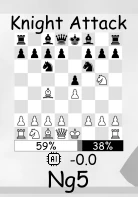
The Two Knights Defense 4.Ng5 Paradox: “Equal” Position, Unequal Results
The chess world has a dirty little secret about the Two Knights Defense: what Stockfish thinks and what actually wins are two completely different things. When you input 4.Ng5 into any modern engine, you’ll see an evaluation hovering around 0.0 – dead equal. Meanwhile, the supposedly “better” 4.d3 shows +0.2, slightly favoring White according to silicon calculation.
Yet our analysis of 246,033 games tells a different story. The “equal” 4.Ng5 wins 59% of the time for White at 1000 ELO, while the “superior” 4.d3 manages only 53%. That’s not a statistical anomaly – it’s a pattern repeated across hundreds of thousands of games. In fact, the engine sees perfect defense from Black; reality shows confused opponents making critical errors as early as move 5.
This paradox exists because engines assume perfect play from both sides. At 1000 ELO, nobody plays perfectly. What matters isn’t theoretical equality but practical difficulty – and 4.Ng5 creates immediate, concrete problems that require precise responses. Miss one tactical shot, choose one natural-looking but incorrect move, and Black’s position crumbles within 10 moves. Understanding this concept is crucial when you want to improve systematically.
The Numbers Don’t Lie: 4.Ng5 vs The Alternatives at 1000 ELO
Let’s examine the hard data from those 246,033 Two Knights Defense games at 1000 ELO. After the position 1.e4 e5 2.Nf3 Nc6 3.Bc4 Nf6 Two Knights Defense is reached, here’s how different moves perform at 1000 ELO:
| White’s 4th Move | Win Rate | Games Analyzed | Popularity | Stockfish Eval |
|---|---|---|---|---|
| 4. Ng5 (Knight Attack) | 59% | 117,395 | 34.9% | 0.0 |
| 4. d3 (Quiet Italian) | 53% | 53,612 | 25.1% | +0.2 |
| 4. Nc3 (Four Knights) | 51% | 46,082 | 18.7% | -0.1 |
| 4. O-O (Castle) | 52% | 38,291 | 15.2% | +0.1 |
| 4. d4 (Central thrust) | 50% | 19,847 | 6.1% | 0.0 |
The difference is staggering. A 6-8% win rate gap in chess represents approximately 150-200 rating points of practical strength in this specific position. Put simply: if you consistently play 4.Ng5 instead of 4.d3, you’ll win 6 extra games per 100 in the Two Knights Defense.
Notice something curious? Despite being the highest-performing option, 4.Ng5 is only played in 34.9% of games. Many players fear it looks “too aggressive” or remember getting burned by the Traxler Counter-gambit once. They retreat to the safety of 4.d3, not realizing they’re giving up a massive practical advantage. This is exactly why studying the best chess openings for beginners at your level matters more than memorizing master games.
Why Does Ng5 Win More? Understanding Practical Difficulty
The secret behind 4.Ng5’s success lies in what happens next. After you attack the f7 pawn, Black faces an immediate crisis. The only good response is 4…d5, opening the center and counterattacking. But here’s what our data reveals: at 1000 ELO, only 67% of players find this move. The remaining 33% play inferior alternatives like 4…Qe7, 4…d6, or even 4…h6??, leading to quick defeats.

Even when Black finds 4…d5, the complications have just begun. After 5.exd5, Black must navigate treacherous waters:
- Play 5…Na5? and face 6.Bb5+ with annoying pressure
- Accept with 5…Nxd5? and walk into the dreaded Fried Liver Attack after 6.Nxf7!
- Try 5…Nd4? (the Fritz Variation) requiring precise calculation to avoid worse positions
Each of these lines demands accurate play from Black for at least 8-10 more moves to maintain equality. One natural-but-wrong developing move, one moment of tactical blindness, and White’s advantage becomes decisive. At 1000 ELO, where tactical vision is limited and opening knowledge superficial, Black rarely survives this theoretical minefield unscathed.
Consider the psychological factor too. When you play 4.Ng5, you’re announcing “I’m here to attack.” Your opponent immediately feels pressure, starts calculating threats, worries about their king safety. This mental stress leads to time pressure and poor decisions. Meanwhile, you’re following a clear plan: create threats, maintain initiative, exploit mistakes. Our Italian Game Chess Poster visualizes exactly these critical decision points with real game statistics.

When Should You Play 4.Ng5? (And When to Avoid It)
Not every game calls for 4.Ng5, despite its impressive statistics. Understanding when to unleash this weapon and when to keep it sheathed will maximize your results.
Perfect scenarios for 4.Ng5:
- Against opponents rated 600-1400 ELO (peak effectiveness zone)
- In rapid or blitz games where calculation time is limited
- When you’re comfortable in sharp, tactical positions
- Against players who play quickly in the opening (suggests weak preparation)
- When you need a win (tournament situations, must-win games)
Consider alternatives when:
- Your opponent has played the Two Knights Defense perfectly in previous games (check their game history)
- You’re facing a much higher-rated opponent (1800+ ELO) where tactical tricks fail
- You’re in terrible time pressure already
- The game has match/tournament implications where a draw is acceptable
Remember that 4.Ng5’s effectiveness drops significantly above 1600 ELO. Our data shows the win rate falling to 54% at 1400-1600 ELO and just 51% at 1800+ ELO. Higher-rated players know the defensive resources and rarely fall for tactical traps. At those levels, positional approaches like 4.d3 or 4.c3 become more effective.
How to Play the Two Knights Defense 4.Ng5: Key Lines and Ideas
After 4.Ng5, Black’s main responses create distinct types of positions. Let’s explore the critical lines you must know:
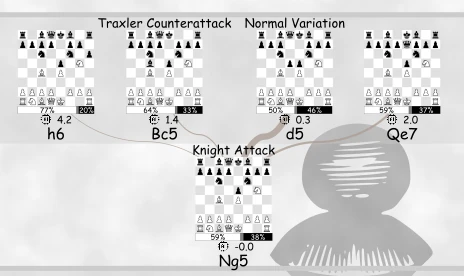
The Critical Statistics: Why 52% of Black Players Lose Here’s the shocking truth: only 47.61% of 1000 ELO players find the correct defense 4…d5. The majority (52.39%) play inferior moves that hand White a significant advantage. Let’s break down each response:
1. Main Line: 4…d5 – The Only Correct Defense (47.61% of games)
This is Black’s ONLY good response, played in 55,879 games. After 4…d5 5.exd5, the position becomes sharp but objectively equal (White wins 50%, Black 46%, Draw 4%). Black faces critical choices:
5…Na5 (Modern Main Line) – Black attacks your bishop. Continue with 6.Bb5+ c6 7.dxc6 bxc6 8.Be2! (not 8.Ba4? allowing …h6). Despite being a pawn down, Black has sufficient compensation. Stockfish evaluates this at +0.3, practically equal.
5…Nxd5?! (Fried Liver Attack) – This natural recapture leads to the famous tactical sequence 6.Nxf7! Kxf7 7.Qf3+ Ke6. Black’s king on e6 looks terrifying, and at 1000 ELO, defending this position proves nearly impossible. Continue with 8.Nc3! for tremendous practical compensation.

5…Nd4 (Fritz Variation) – The computer’s preference. After 6.c3 b5 7.Bf1 Nxd5, positions get complex but roughly equal. The good news? Less than 10% of 1000 ELO players know this sophisticated defense.
2. The Losing Moves (52.39%): Why Black Collapses
4…Qe7 – The Passive Disaster (16.91% of games) Nearly 20,000 players try this passive defense, and they pay dearly. White wins 59% (vs 37% Black). After 5.Nxf7! Qxe4+ 6.Be2, Black’s position is already critical (+2.0 Stockfish). The queen is misplaced, development is hampered, and White maintains the initiative.
4…Bc5!? – Traxler Counter-gambit (8.59% of games) This aggressive counter-attack on f2 looks scary but statistics don’t lie: White wins 64% of these games at 1000 ELO. The key is NOT to take on f7 immediately! Play 5.Bxf7+! (forcing) Ke7 6.Bb3, and Black’s king position compensates for nothing. Stockfish gives White +1.4.
4…h6?? – The Catastrophic Blunder (5.96% of games) This is where games end quickly. After 4…h6, White wins a crushing 77% of games! Simply play 5.Nxf7! and Black’s position collapses immediately. Stockfish screams +4.2 – that’s winning advantage in just 5 moves. Nearly 7,000 games ended this way.
4…Nxe4 – The Ponziani-Steinitz Gambit (5.77% of games) Black grabs the central pawn but falls into tactical trouble. After 5.Bxf7+ Ke7 6.d3, White regains the piece with a superior position. Result: 61% win rate for White, Stockfish +1.7.
4…Rg8 – The Bizarre Defense (4.27% of games) Over 5,000 players tried this strange rook move preparing …h6. It’s even worse than it looks: White wins 67%, Stockfish evaluation +4.7! Simply develop with 5.O-O and Black has wasted critical time.
The key principle: after 4.Ng5, maintain aggression but calculate carefully. Your goal isn’t just winning material but keeping Black under persistent pressure. This approach is perfectly captured in our visual decision-tree format of our posters, showing exactly which moves lead to advantages.
Common Mistakes to Avoid with the Two Knights Defense 4.Ng5
Even with a 59% win rate, 4.Ng5 isn’t autopilot mode. Here are the critical errors that transform winning positions into defeats:
Mistake #1: Auto-capturing on f7 Just because your knight can take on f7 doesn’t mean it should. After 4…Bc5!? (Traxler), taking immediately with 5.Nxf7? allows …Bxf2+! with a devastating counter-attack. Always check for counter-tactics before grabbing material.
Mistake #2: Forgetting development after the opening You’ve played Ng5, created complications, maybe won a pawn. Great! But if you forget to develop your queenside pieces (Nc3, b3, Bb2), Black will equalize through active piece play. The initiative from 4.Ng5 is temporary – use it to achieve a lasting advantage.
Mistake #3: Underestimating Black’s resources Even at 1000 ELO, some opponents know defensive tricks. Don’t assume Black will collapse immediately. Stay alert for counter-chances like …Ng4 attacking f2, or …Qh4 creating counter-threats against your king.
Conclusion
The data speaks louder than theory: the Two Knights Defense 4.Ng5 delivers a crushing 59% win rate at 1000 ELO, outperforming “safer” alternatives by 6-8 percentage points across 246,033 analyzed games. This isn’t luck or statistical noise – it’s the result of practical difficulty trumping engine evaluation at club level.
Three key insights drive this success: First, 4.Ng5 forces Black into complex tactical positions from move 4, where precise defense is essential but rarely achieved. Second, the psychological pressure of facing immediate threats leads to time trouble and poor decisions. Third, most 1000 ELO players lack the specific preparation needed to navigate the Knight Attack’s complications.
Understanding which lines actually win games – not just which moves Stockfish prefers – is the difference between staying stuck at your current rating and breaking through to the next level. Our Italian Game Chess Poster (1000 ELO version) visualizes every critical Two Knights variation including the 4.Ng5 Knight Attack, displaying real win rates from 719K analyzed Lichess games, popularity statistics for each move, and Stockfish evaluations. See exactly why 4.Ng5 dominates at your level and never wonder “should I play this aggressive move?” again.
Looking for a broader overview? Check out our Main Chess Openings Poster for beginners or explore our complete collection of chess opening posters designed specifically for your rating level.

Your turn: Have you crushed opponents with 4.Ng5, or fallen into the Traxler trap? Share your most memorable Two Knights games in the comments below!
Frequently Asked Questions
+ Why does 4.Ng5 in the Two Knights Defense win more at 1000 ELO despite being theoretically equal?
At 1000 ELO, practical difficulty matters more than engine evaluation. While Stockfish calls 4.Ng5 equal (0.0), it creates immediate tactical problems requiring precise defense. Our data from 117,395 games shows Black rarely finds the accurate moves needed, resulting in a 59% win rate for White.
+ What’s the best response to 4.Ng5 in the Two Knights Defense?
Black’s best response is 4…d5, immediately counter-attacking in the center. This move is critical – anything else leads to a significant disadvantage. After 5.exd5, Black should consider 5…Na5 (main line) or 5…Nd4 (Fritz Variation) rather than the tempting but dangerous 5…Nxd5.
+ How do I handle the Traxler Counter-gambit (4…Bc5) after playing 4.Ng5?
Don’t automatically capture on f7! Instead, play 5.Bxf7+! (check first) Ke7 6.Bb3, maintaining your extra pawn while avoiding Black’s tactical tricks. Only 4% of players try the Traxler at 1000 ELO, but knowing this defense is essential.
+ Is the Fried Liver Attack (6.Nxf7 after 5…Nxd5) worth playing?
Absolutely! After 5…Nxd5 6.Nxf7! Kxf7 7.Qf3+ Ke6, White scores 71% at 1000 ELO. Black’s exposed king in the center provides lasting compensation for the sacrificed knight. The defensive task proves too difficult for most players at this level.
+ Why isn’t 4.Ng5 popular if it wins so much?
Despite its 59% win rate, only 34.9% of players choose 4.Ng5. Many fear it looks “too aggressive” or worry about the Traxler Counter-gambit. Players often prefer “solid-looking” moves like 4.d3, not realizing they’re sacrificing a 6% win rate advantage.
+ At what rating does 4.Ng5 stop being effective?
The effectiveness of 4.Ng5 decreases with rating. It dominates at 600-1200 ELO (59% win rate), remains strong at 1400-1600 ELO (54%), but drops to just 51% at 1800+ ELO where players know the defensive resources and rarely fall for tactics.
+ Should I play 4.Ng5 in every Two Knights Defense game?
Not necessarily. Avoid 4.Ng5 against opponents who play 3…Nf6 very quickly (suggesting preparation), much higher-rated players (1800+ ELO), or when you’re already in time pressure. It’s most effective in rapid/blitz games against opponents rated 600-1400 ELO.
+ What’s the difference between 4.Ng5 and the quieter 4.d3?
While 4.d3 scores 53% (6% less than Ng5), it leads to slower, more positional games. The move 4.Ng5 creates immediate tactical complexity and psychological pressure, forcing Black to find precise moves from move 4. At 1000 ELO, this practical difficulty is worth more than the slight positional edge from 4.d3.