
The Ruy Lopez Closed 1600-2000 ELO data reveals a shocking truth: one single move flips Black’s win rate entirely. Nicknamed “The Spanish Torture,” this opening supposedly crushes Black for 40, 50, sometimes 60 moves. But what if that reputation is wrong at your level?
Here’s the data that changes everything: in the Ruy Lopez Closed variation after 5.O-O Be7, Black wins 47% of games while White wins only 45% — across 34,621 Lichess games at 1600-2000 ELO. Compare this to 5…b5, where White crushes with 51% versus Black’s 42%. That’s a 13-point swing based on one move choice. At your level, understanding this move order decision separates players who suffer through the Spanish Torture from those who turn it into Black’s weapon.
Ruy Lopez Closed 1600-2000 ELO: Why 5…Be7 Beats 5…b5 by 13 Points
What exactly is the Ruy Lopez Closed variation? After 1.e4 e5 2.Nf3 Nc6 3.Bb5 a6 4.Ba4 Nf6 5.O-O, Black faces a critical crossroads. The Closed Defense with 5…Be7 leads to strategic middlegames where Black builds a solid fortress before counterattacking. The alternative, 5…b5 (Arkhangelsk/Open variations), immediately challenges White’s bishop but opens tactical complications.
The statistics tell a clear story. In 34,621 games with 5…Be7, Black achieves 47% wins against White’s 45%. But in 37,187 games with 5…b5, White dominates at 51% versus Black’s 42%. This 13-percentage-point difference represents roughly 200 rating points worth of advantage — simply from knowing which move to play.
Why does Be7 perform so much better? The Closed structure gives Black time to complete development, castle safely, and prepare the d5 break under optimal conditions. At 1600-2000 ELO, players who rush with b5 often mishandle the resulting tactical complications, while the Closed approach rewards patient, strategic play that intermediate players execute more reliably.
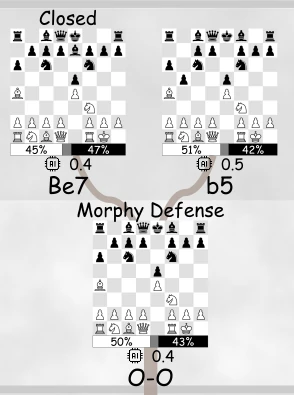
The Critical Move Order Decision After 5.O-O: Be7 vs b5 Explained
Understanding the Ruy Lopez Closed 1600-2000 level dynamics helps you choose the right move order. Why is Be7 played in the Ruy Lopez instead of the more aggressive b5? The answer lies in practical execution versus theoretical sharpness.
When Black plays 5…b5 immediately, White retreats with 6.Bb3 and Black must make another crucial decision. Here’s where move order becomes everything:
- 6.Bb3 Bc5: White wins 54% vs Black’s 40% (16,666 games) — a disaster for Black
- 6.Bb3 Be7: White wins 48% vs Black’s 45% (17,619 games) — much more balanced
Notice the pattern? Be7 is Black’s key equalizing resource regardless of the move order. But by playing 5…Be7 directly, Black avoids the trap of playing Bc5 at the wrong moment entirely. The Closed variation eliminates one potential mistake from Black’s path.
At 1600-2000 ELO, eliminating decision points where you can go wrong is often more valuable than pursuing theoretically sharp lines. The Ruy Lopez Closed variation does exactly this: it channels the game toward positions where Black’s strategic plan is clear and execution errors are less punishing.
Ruy Lopez Closed 1600-2000 ELO Stats: Black Wins 47% vs White’s 45%
Let’s examine the complete statistical picture from Lichess Opening Explorer:
| Black’s 5th Move | White Win Rate | Black Win Rate | Games Analyzed |
|---|---|---|---|
| 5…Be7 (Closed) | 45% | 47% | 34,621 ⭐ |
| 5…b5 (Arkhangelsk) | 51% | 42% | 37,187 |
| 5…Nxe4 (Open) | 49% | 44% | 28,432 |
This data reveals something remarkable: the Ruy Lopez Closed is the only major variation where Black actually wins more than White at the 1600-2000 level. The “Spanish Torture” becomes the “Spanish Opportunity” when you choose the right move order.
The global Ruy Lopez statistics (3.Bb5) show White winning 52% versus Black’s 42% across 1.16 million games. The Closed variation doesn’t just equalize — it reverses the typical Ruy Lopez narrative entirely.
The Bishop Retreat Trap: Why 6.Bb3 Bc5 Crushes Black (54% vs 40%)
Understanding why Bc5 fails helps cement why Be7 succeeds. After 5…b5 6.Bb3, Black often plays Bc5 instinctively — the bishop looks active, it pressures f2, what could go wrong?
Everything, apparently. The data shows White winning 54% versus Black’s 40% after Bc5. That’s a 14-point gap that makes this one of the worst practical choices in the Ruy Lopez at intermediate level.
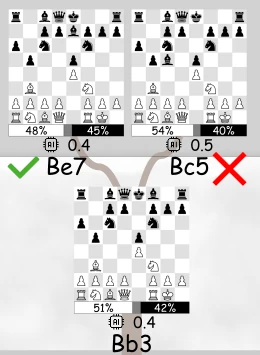
The problem with Bc5 is structural. The bishop on c5 becomes a target after c3-d4, Black loses time retreating, and the e5 pawn becomes weak without the bishop’s support from e7. Meanwhile, White’s center expands aggressively.
Compare this to Be7 in the same position: White wins 48% versus Black’s 45%. The bishop on e7 supports the e5 pawn, prepares kingside castling, and maintains flexibility for later redeployment to f6 or g5 in some lines. Position trumps activity when structure is at stake.
Ruy Lopez vs Italian Game: Which Opening Gives Black Better Chances?
For players studying the Ruy Lopez Closed 1600-2000 ELO range, this comparison with the Italian Game is essential. A common question for players building a repertoire: should you steer toward the Italian Game or the Ruy Lopez as Black? The data provides a clear answer at 1600-2000 ELO.
In the Italian Game (3.Bc4), White typically scores around 50-52% across all variations. The Ruy Lopez globally favors White at 52%. However, the Ruy Lopez Closed variation specifically gives Black 47% — better than most Italian Game defenses.
This creates an interesting strategic choice. If your opponent plays 3.Bb5, you can:
- Play the Closed (5…Be7): Achieve 47% win rate, strategic positions
- Play the Berlin (3…Nf6 4.O-O Nxe4): Achieve solid equality but often drawish
- Play the Open/Arkhangelsk: Risk the 42% win rate with sharper play
For players who want winning chances without excessive risk, the Ruy Lopez Closed variation offers the best statistical profile. It combines fighting positions with a genuine Black advantage — a rare combination against 1.e4.
As explored in our article on best chess openings understanding these statistical differences helps build repertoires based on what actually wins games, not what looks impressive in opening books.
Ruy Lopez Closed 1600-2000 ELO: How to Apply Move Order Knowledge
Converting statistical knowledge into practical improvement requires understanding when and why these numbers matter at your level.
At 1600-2000 ELO, prioritize these principles:
First, play 5…Be7 automatically when reaching this position. Don’t calculate whether b5 might work “this time” — the statistics across 70,000+ games already provide the answer.
Second, if you’ve already played 5…b5 (or your opponent’s move order leads there), always choose Be7 over Bc5 when given the option. The 14-point difference is simply too large to ignore.
Third, understand the strategic plan after Be7: complete development with O-O, play d6 to support e5, then prepare the d5 break when properly supported. This plan executes more reliably than the tactical complications after b5.
Our Main Chess Openings Poster (1600-2000 ELO) visualizes exactly these critical branching points with real Lichess win rates. Instead of memorizing variations, you see the decision tree structure that makes move order intuitive.
Visual Decision Tree: Seeing the Critical Fork After 5.O-O
The Ruy Lopez contains over 20 critical move-order decisions like the 5…Be7 versus 5…b5 choice. Each junction can swing your results by 10-15 percentage points. Memorizing them all through traditional study is overwhelming — but visualizing them changes everything.
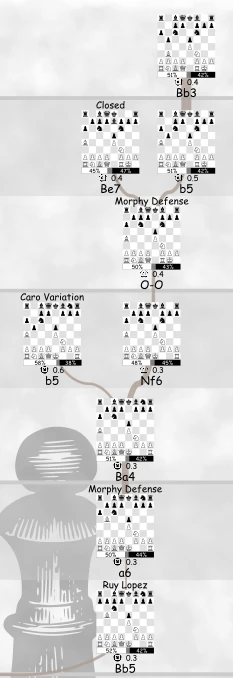
A decision tree format shows you:
- Where the critical forks occur (5.O-O is a key decision point)
- Which branch leads to better statistics (Be7 = 47% for Black)
- Why alternatives fail (b5 + Bc5 = 40% disaster)
This visual pattern recognition approach aligns with how strong players actually think about openings. They don’t memorize move sequences — they recognize decision points and know which direction wins more games.
Ruy Lopez Closed 1600-2000 ELO: conclusion
Mastering the Ruy Lopez Closed 1600-2000 move order gives you a statistical edge that theory books miss. The Ruy Lopez Closed variation with 5…Be7 transforms one of White’s most feared weapons into a genuine Black advantage. The key takeaways from our analysis of 70,000+ Lichess games:
- 5…Be7 wins 47% for Black versus 45% for White — the only Ruy Lopez line where Black outscores White at 1600-2000 ELO
- 5…b5 drops to 42% for Black — a 13-point swing from one move choice
- Bc5 is the critical trap to avoid (54% White, 40% Black after 6.Bb3 Bc5)
- Be7 is Black’s universal equalizer regardless of move order
These statistics reveal what theory books often miss: practical difficulty matters more than engine evaluation. The Closed Defense succeeds because it’s easier to execute correctly, not because it’s objectively better according to Stockfish.
The Ruy Lopez has 20+ critical move-order decisions like this — and each one can swing your result by 10-15 percentage points. Our Main Chess Openings Poster (1600-2000 ELO) reveals every key branching point with real Lichess data, including the complete Ruy Lopez decision tree. See exactly why Be7 dominates and never wonder “which move wins more?” again.
Your turn: Do you play the Closed Defense or prefer sharper lines like the Marshall Attack? Share your experience with the Ruy Lopez in the comments below.
Frequently Asked Questions
Q1: What is the closed variation of the Ruy Lopez?
A: The Ruy Lopez Closed variation occurs after 1.e4 e5 2.Nf3 Nc6 3.Bb5 a6 4.Ba4 Nf6 5.O-O Be7. Black develops the bishop to e7 instead of immediately challenging White’s center with b5. This leads to strategic middlegames where Black builds a solid position before counterattacking. At 1600-2000 ELO, it achieves 47% wins for Black versus 45% for White.
Q2: Why is Be7 played in the Ruy Lopez?
A: Be7 is played because it supports the e5 pawn, completes kingside development safely, and avoids tactical complications. Lichess data shows 5…Be7 achieves 47% wins for Black, while 5…b5 drops to 42%. The move eliminates potential errors and channels the game toward positions where Black’s strategic plan is clear and reliable.
Q3: Is the Ruy Lopez better than the Italian Game?
A: At 1600-2000 ELO, the Ruy Lopez Closed variation (5…Be7) gives Black 47% wins — better than most Italian Game defenses where Black typically scores 44-46%. If you want winning chances without excessive risk, the Closed Defense offers the best statistical profile against 1.e4 e5 3.Bb5.
Q4: What is the best response to the Ruy Lopez as Black?
A: Statistically, the Closed Defense with 5…Be7 is Black’s best response at intermediate level. It achieves 47% wins versus White’s 45% across 34,621 games. The Berlin Defense is also solid but often drawish. Avoid 5…b5 followed by Bc5, which drops Black’s win rate to 40%.
Q5: What is the purpose of 5…Be7 in the Ruy Lopez?
A: The purpose of 5…Be7 is threefold: it defends the e5 pawn indirectly, prepares immediate castling, and maintains flexibility for future piece placement. Unlike 5…b5, it doesn’t commit to tactical complications early. This practical approach wins 5 more percentage points at 1600-2000 ELO.
Q6: Why is the Ruy Lopez called the Spanish Torture?
A: The Ruy Lopez is called “The Spanish Torture” because White typically maintains long-term pressure against Black’s position. However, data shows this reputation doesn’t apply to the Closed Defense: Black actually wins more (47% vs 45%) when playing 5…Be7. The “torture” mainly affects players who choose inferior variations like 5…b5.
Q7: Is the Marshall Attack good for Black?
A: The Marshall Attack (5…Be7 6.Re1 b5 7.Bb3 O-O 8.c3 d5) is a sharp gambit that sacrifices a pawn for attacking chances. While theoretically interesting, it requires precise preparation. For players who prefer statistical safety, the standard Closed lines without the Marshall offer more consistent results at intermediate level.
Q8: What is the difference between Ruy Lopez Open and Ruy Lopez Closed 1600-2000 ELO?
A: The Open Ruy Lopez (5…Nxe4) immediately grabs White’s e4 pawn, leading to tactical positions. The Closed Ruy Lopez (5…Be7) keeps the center stable, leading to strategic middlegames. Statistically, the Closed achieves 47% for Black while the Open scores around 44% — making the Closed more reliable at 1600-2000 ELO.