
You’ve heard it a thousand times: “The Fried Liver Attack is theoretically unsound.” Stockfish evaluates the position after 5.Nxf7 at merely +0.9 for White. And yet, something feels terrifyingly wrong when you face it across the board. The Fried Liver Attack 1600-2000 ELO win rate reaches a staggering 71% for White—and this article reveals exactly why this “refuted” sacrifice dominates in practice.
Here’s what the data actually shows: the fried liver attack 1600-2000 ELO win rate reaches a staggering 71% for White. That’s not a typo. Across 43,639 Lichess games at this level, White crushes Black nearly three out of four times.
That’s not a typo. Across 43,639 Lichess games at this level, White crushes Black nearly three out of four times. This article reveals why this “refuted” sacrifice dominates in practice, which defensive mistakes cost you the game before the sacrifice even lands, and how to finally escape this tactical nightmare.
What Is the Fried Liver Attack 1600-2000 ELO Win Rate Secret?
The Fried Liver Attack emerges from the Italian Game after 1.e4 e5 2.Nf3 Nc6 3.Bc4 Nf6 4.Ng5 d5 5.exd5 Nxd5 6.Nxf7. White sacrifices a knight to drag Black’s king into the center of the board, launching a ferocious attack against an exposed monarch.
The name “Fried Liver” comes from the Italian “Fegatello,” meaning a piece of liver used as bait. And that’s exactly what White offers: material for devastating initiative.
But here’s the paradox that confuses players. Stockfish considers 5.Nxf7 roughly equal—an evaluation of +0.9 isn’t winning. So why does White’s fried liver attack win rate hit 71% at club level?
The answer lies in practical difficulty. Engine evaluation assumes perfect play from both sides. At 1600-2000 ELO, Black must find a series of only-moves while their king wanders through enemy territory. One inaccuracy, and the attack becomes unstoppable. White, meanwhile, plays natural aggressive moves that flow logically from the position.
This creates the ultimate asymmetry: White has fun attacking; Black suffers defending. And suffering leads to mistakes.
Fried Liver Attack 1600-2000 ELO: The Shocking 71% Win Rate Data
The fried liver attack win rate 1600-2000 ELO data comes from 43,639 games. Let’s examine the numbers directly from Lichess. After 5…Nxd5 6.Nxf7 (the Fried Liver proper), here’s how games end at 1600-2000 ELO:
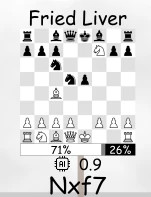
A 45-point win rate advantage is extraordinary. For context, having White pieces typically gives a 3-5% edge. The Fried Liver multiplies that advantage by nearly ten times.
What makes these numbers even more remarkable: this is the highest win rate for any mainline variation with significant volume in the entire Italian Game dataset. Not the quiet Italian. Not the Giuoco Piano. The “theoretically dubious” Fried Liver Attack.
Consultez le Lichess Opening Explorer pour explorer ces statistiques par niveau ELO.
The Critical Mistake: Why 4…Nxd5 Loses Before the Sacrifice Even Happens
Here’s what most articles miss: Black’s position is already collapsing before the Fried Liver sacrifice. Understanding the fried liver attack win rate 1600-2000 ELO means recognizing that the critical error happens at move 5, not move 6.
After 4.Ng5 d5 5.exd5, Black faces the decisive crossroads:
| Black’s Response | White Win Rate | Black Win Rate | Games |
|---|---|---|---|
| 5…Nxd5 (enters Fried Liver) | 65% | 31% | 71,211 |
| 5…Na5 (Polerio Defense) | 44% | 52% | 58,394 |
| 5…b5 (Ulvestad Variation) | 51% | 45% | 12,847 |
The difference is staggering. By choosing 5…Nxd5 instead of 5…Na5, Black’s win rate drops by 21 percentage points. The game is essentially decided before the knight even lands on f7.
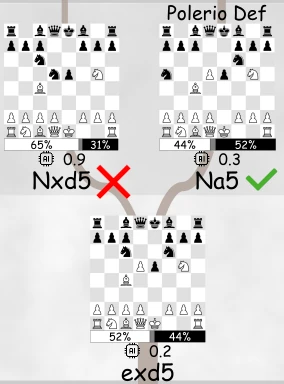
Why does 5…Na5 (the Polerio Defense) reverse everything? Because it counterattacks White’s bishop on c4 while avoiding the king march. Black temporarily sacrifices a pawn but maintains king safety—the most precious asset in tactical positions.
Understanding this decision tree is exactly what separates improving players from those stuck at plateau. Our Main Chess Openings Poster for 1600-2000 ELO visualizes this critical branching point with actual win rates, so you see immediately which path leads to 71% losses.
Does the Anti-Fried Liver Defense (3…h6) Actually Work? The Data Says No
Many players, burned by the Fried Liver, adopt a “preventive” strategy: play 3…h6 before developing the knight to f6. This Anti-Fried Liver Defense kicks away the Ng5 idea permanently.
Logical, right? Except the data reveals a painful truth:
| Defense Strategy | White Win Rate | Black Win Rate | Games |
|---|---|---|---|
| 3…Nf6 (normal) then handling Ng5 | 51% | 45% | Combined mainlines |
| 3…h6 (Anti-Fried Liver) | 55% | 40% | 289,462 |
The “safe” move 3…h6 performs worse than playing normally and facing the Ng5 threat. White scores 55% with Black limping to just 40%—a 15-point deficit.
Why does the anti-system fail? Because 3…h6 wastes a tempo on a purely defensive move that doesn’t develop pieces or control the center. White simply plays 4.d4, opens the position, and exploits Black’s slow development. You’ve avoided one problem (Fried Liver) by creating another (inferior position).
This counterintuitive result appears frequently in chess: “avoiding” tactical complications often leads to worse positions than facing them head-on with the correct response.
How to Survive the Fried Liver Attack 1600-2000 ELO: The Polerio Defense Explained
If you’re facing the Fried Liver regularly, here’s your escape route: the Polerio Defense with 5…Na5.
After 1.e4 e5 2.Nf3 Nc6 3.Bc4 Nf6 4.Ng5 d5 5.exd5 Na5, Black attacks the c4 bishop while sidestepping the deadly Nxf7 sacrifice. The main continuation runs 6.Bb5+ c6 7.dxc6 bxc6 8.Be2 h6.
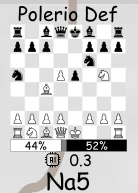
Notice the complete reversal: Black now wins 52% versus White’s 44%. By switching from 5…Nxd5 to 5…Na5, Black transforms a losing position into a winning one. That’s a 31-point swing in win probability from a single move choice.
The Polerio Defense works because:
- It counterattacks immediately — White must address the bishop threat
- The king stays safe — No Kxf7 walks through enemy fire
- Black gets active piece play — The Na5 knight can reroute to c4 or b7
For deeper analysis of how these variations connect, see our guide on Sicilian Defense vs Italian Game for beginners—understanding transpositional choices helps you navigate complex opening theory.
Fried Liver vs Traxler vs Fritz: Which Defense Has the Best Win Rate?
When Black plays 4…Nf6 and accepts the challenge against 4.Ng5, several defensive systems emerge. Here’s how they compare at 1600-2000 ELO:
| Defense | Move Order | Black Win Rate | Risk Level |
|---|---|---|---|
| Polerio Defense | 5…Na5 | 52% | Low |
| Ulvestad Variation | 5…b5 | 45% | Medium |
| Traxler Counterattack | 4…Bc5!? | 43% | High |
| Fritz Variation | 5…Nd4 | 38% | Very High |
| Fried Liver (taking) | 5…Nxd5 | 31% | Extreme |
The Traxler Counterattack (4…Bc5!?) offers an interesting alternative: Black ignores the f7 threat and counterattacks f2. It’s spectacular chess but statistically risky, with Black scoring just 43%.
The Fritz Variation (5…Nd4) attempts to complicate matters with knight maneuvers but scores even worse at 38%. Both options are inferior to the clean Polerio Defense.
Key insight: the safest defense is also the most successful. Unlike many chess positions where risk equals reward, the Fried Liver punishes aggressive defensive tries. Play solid, play Na5, win 52%.
Visual Decision Tree: See Every Critical Move at Your ELO Level
The Italian Game contains 15+ critical branching points like the Fried Liver decision. Most players study these variations in isolation, memorizing moves without understanding the connections.
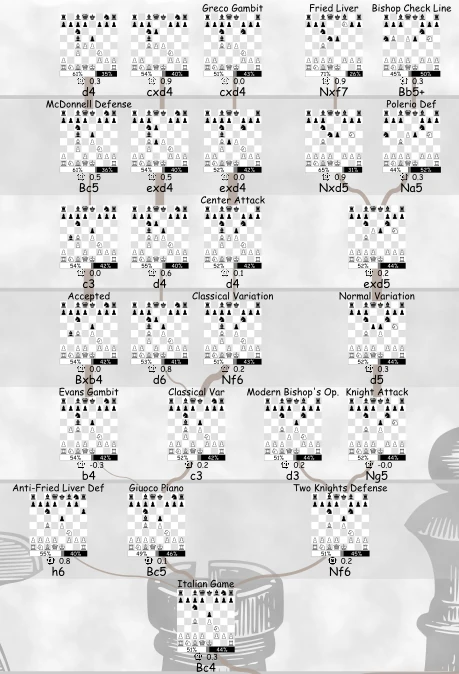
A visual decision tree solves this problem. When you see the entire structure—where 5…Na5 leads versus 5…Nxd5, how 3…h6 connects to the mainline, which transpositions are safe—the opening becomes intuitive rather than memorized.
This is exactly why data-driven visualization accelerates learning. You’re not asking “what’s the move?” but seeing “what are the consequences?”
Fried Liver Attack 1600-2000 ELO: Conclusion
The fried liver attack win rate 1600-2000 ELO of 71% reveals a fundamental truth about practical chess: theoretical evaluation and practical results often diverge dramatically. Three key takeaways:
- The game is decided at move 5 — Choosing 5…Nxd5 instead of 5…Na5 costs Black 21 percentage points in win rate
- “Safe” prevention backfires — The Anti-Fried Liver Defense (3…h6) scores worse than facing Ng5 directly
- The Polerio Defense works — 5…Na5 transforms a 31% Black win rate into 52%
Understanding which lines actually win games is crucial for climbing from 1600 to 2000 ELO. Our Main Chess Openings Poster (1600-2000 ELO version) shows every critical Two Knights variation—including the Fried Liver Attack and Polerio Defense—with real win rates from Lichess games. See exactly why 5…Nxd5 costs you games, and never fall into the 71% trap again.
View the Main Chess Openings Poster 1600-2000 ELO →
Your turn: Have you been crushed by the Fried Liver, or do you play it as White? Share your most memorable game in the comments below.
Frequently Asked Questions
Q1: What is the Fried Liver Attack in chess?
A: The Fried Liver Attack is an aggressive opening after 1.e4 e5 2.Nf3 Nc6 3.Bc4 Nf6 4.Ng5 d5 5.exd5 Nxd5 6.Nxf7. White sacrifices a knight to expose Black’s king. At 1600-2000 ELO, this sacrifice wins 71% of games for White despite engine evaluations calling it “equal.”
Q2: Does the Fried Liver Attack actually work at 1600-2000 ELO?
A: Yes, dramatically. Lichess data shows White wins 71% of Fried Liver games at 1600-2000 ELO across 43,639 games. The attack works because Black must find precise defensive moves while their king is exposed—something club players rarely achieve under pressure.
Q3: How do you defend against the Fried Liver Attack at 1600-2000 ELO?
A: The best defense is the Polerio Defense: after 4.Ng5 d5 5.exd5, play 5…Na5 instead of 5…Nxd5. This counterattacks White’s bishop and avoids the king march. Black scores 52% with this system versus just 31% in the main Fried Liver line.
Q4: Why is it called the Fried Liver Attack?
A: The name comes from the Italian “Fegatello,” meaning a piece of liver used as bait. The knight sacrifice on f7 is the “bait” that lures Black’s king into a deadly hunt. Italian players used this term in the 16th century when the attack was first analyzed.
Q5: Is the Fried Liver Attack sound at high levels?
A: Theoretically, Black can defend with precise play (engine evaluation +0.9). However, even at 1600-2000 ELO, White still wins 71%. At master level, the attack is less effective but rarely occurs because strong players avoid 5…Nxd5 entirely.
Q6: What is the Traxler Counterattack?
A: The Traxler Counterattack (4…Bc5) is Black’s aggressive alternative to defending f7. Instead of stopping Nxf7, Black counterattacks f2. It’s spectacular but risky—Black scores only 43% at 1600-2000 ELO compared to 52% with the Polerio Defense.
Q7: Does the Anti-Fried Liver Defense (3…h6) work?
A: No. Surprisingly, 3…h6 scores worse than normal play: White wins 55% versus Black’s 40% across 289,462 games. The tempo loss allows White to build a strong center with d4, creating different but equally severe problems.
Q8: What is the best response to the Fried Liver Attack at 1600-2000 ELO?
A: Avoid it entirely with 5…Na5 (Polerio Defense). If you’ve already played 5…Nxd5 and face 6.Nxf7, the main line continues 6…Kxf7 7.Qf3+ Ke6—but at this point, Black is already suffering statistically with only 31% win rate.