
You’ve been searching for an Italian Game chess opening diagram because you’re tired of reading walls of text about 1.e4 e5 2.Nf3 Nc6 3.Bc4. You want to SEE the opening, not just read about it. You want a visual map showing where each move leads, what your options are, and which lines actually win games at your level. Standard opening guides give you endless variations without a clear picture of how they connect. That’s frustrating.
This Italian Game chess opening diagram guide takes a different approach. Instead of burying you in text, we’ll show you exactly how the Italian Game branches into its main variations through visual decision trees backed by real data. Our analysis of thousand of Lichess games reveals which moves actually perform best at different rating levels, from 0 to 2000 ELO. You’ll finally understand not just WHAT to play, but WHY each branch leads where it does.
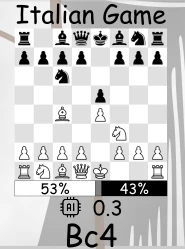
Understanding the Italian Game Chess Opening Diagram
The Italian Game begins after 1.e4 e5 2.Nf3 Nc6 3.Bc4. White develops the bishop to its most aggressive square, aiming directly at Black’s f7 pawn, the weakest point in Black’s position since only the king defends it. This simple idea has made the Italian Game one of the oldest and most enduring chess openings, played from beginner tournaments to World Championship matches.
What makes this opening perfect for visual learning? The Italian Game branches clearly into distinct paths based on Black’s third move response. Unlike some openings where move orders blur together, the Italian creates a clean decision tree: Black plays either 3…Bc5 (the Giuoco Piano) or 3…Nf6 (the Two Knights Defense), and each choice leads to completely different middlegame structures.
The board position after 3.Bc4 contains hidden tension. White threatens nothing immediately, but the bishop’s diagonal pressure creates long-term strategic themes. Visualizing these themes through diagrams helps you understand why certain moves work better than others, rather than memorizing sequences blindly.
Italian Game Diagram: The Main Branches Explained
A proper Italian Game chess opening diagram reveals three main branches after the starting position. Each branch has distinct characteristics that suit different playing styles.
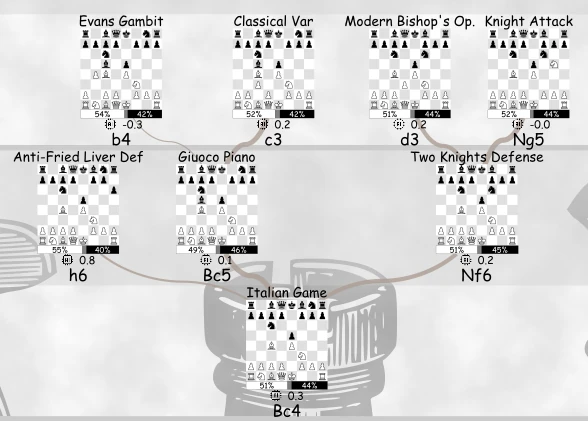
Branch 1: The Giuoco Piano (3…Bc5) represents the classical approach. Black mirrors White’s development, creating symmetrical tension. This leads to strategic middlegames where understanding plans matters more than memorizing long tactical sequences. At 1000 ELO, White wins 54% of Giuoco Piano games.
Branch 2: The Two Knights Defense (3…Nf6) invites tactical complications. Black challenges White’s center immediately, and after 4.Ng5, the game can explode into sharp tactical play with the famous Fried Liver Attack. Data shows this line requires more precise play from both sides.
Branch 3: Sidelines like 3…d6 or 3…Be7 appear occasionally but score poorly for Black. Understanding why these moves fail helps you punish opponents who deviate from main lines.
Win Rate Analysis by ELO Level
Here’s where visual data becomes powerful. The same move performs differently at different rating levels. A move that crushes 1000-rated players might be neutralized by 2000-rated opponents who know the theory.
| Win-rate statistics by variations & ELO | 0-800 ELO | 1000 ELO | 1200 ELO | 1400 ELO | 1600-2000 ELO |
|---|---|---|---|---|---|
| Giuoco Piano (3…Bc5 4.c3) | 57% white / 38% black | 56% white / 39% black | 56% white / 40% black | 54% white / 41% black | 52% white / 42% black |
| Giuoco Pianissimo (3…Bc5 4.d3) | 52% white / 43% black | 52% white / 44% black | 50% white / 46% black | 48% white / 48% black | 45% white / 49% black |
| Evans Gambit (3…Bc5 4.b4) | 58% white / 39% black | 56% white / 41% black | 56% white / 41% black | 55% white / 42% black | 55% white / 42% black |
| Knight Attack (3…Nf6 4.Ng5) | 61% white / 35% black | 59% white / 38% black | 58% white / 39% black | 58% white / 40% black | 52% white / 44% black |
| Modern Bishop’s Op. (3…Nf6 4.d3) | 51% white / 43% black | 53% white / 43% black | 53% white / 43% black | 54% white / 42% black | 51% white / 44% black |
| Four Knights Game (3…Nf6 4.Nc3) | 51% white / 43% black | 51% white / 44% black | 51% white / 44% black | 50% white / 42% black | 46% white / 44% black |
| Anti-Fried Liver (3… h6) | 41% white / 54% black | 45% white / 50% black | 49% white / 47% black | 52% white / 44% black | 55% white / 40% black |
Notice the pattern: aggressive lines like Knight Attack (3…Nf6 4.Ng5) perform exceptionally well at lower ratings (59% at 1000 ELO) but normalize as opponents improve. This insight only becomes clear when you visualize the data across ELO ranges. Choosing your variation based on your actual rating level, not what grandmasters play, gives you a concrete competitive advantage.
The Giuoco Piano Diagram: Strategic Positions Explained
The Giuoco Piano (“Quiet Game” in Italian) arises after 3…Bc5. Despite its calm name, this variation contains plenty of strategic venom. The typical continuation runs 4.c3 Nf6 5.d4 exd4 6.cxd4 Bb4+ 7.Bd2, reaching a critical position that appears in thousands of games.
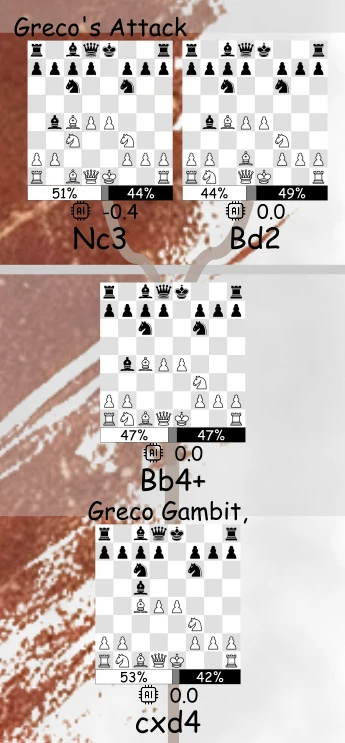
What does a diagram reveal that text cannot? You can immediately see White’s powerful d4-e4 pawn center, the pressure on Black’s position, and why Black needs to challenge this center quickly. Visual learners grasp these relationships instantly, while text descriptions require mental reconstruction.
The Giuoco Piano structure favors players who understand central control and piece coordination. White aims to maintain the pawn duo while developing pieces to active squares. Black must strike back with moves like d5 to prevent White from consolidating a space advantage.
The Two Knights Defense Diagram: Tactical Fireworks
After 3…Nf6, the game takes a sharper turn. White’s most aggressive response is 4.Ng5, threatening the f7 pawn directly. This creates the famous position where Black must choose between the solid 4…d5 or the wild Traxler Counterattack with 4…Bc5.
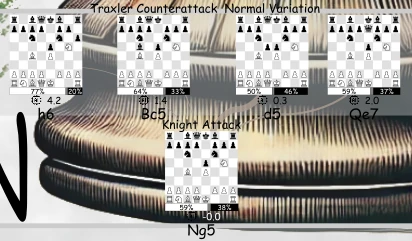
The diagram of this position shows immediate tactical tension that differs completely from the Giuoco Piano. White’s knight on g5 creates threats, Black’s pieces must respond precisely. At 1000 ELO, this tactical pressure translates into a remarkable 59% win rate for White.
Why does 4.Ng5 crush at lower levels? The visual answer is clear: Black faces multiple threats simultaneously, and finding the correct defensive sequence requires exact calculation. Players who understand the pattern from diagrams handle these positions better than those who’ve only read about them.
After 4…d5 5.exd5 Na5, Black counterattacks White’s bishop while accepting a temporarily awkward knight position. This sequence appears complex in notation but becomes logical when you see the board positions in sequence. Each move flows naturally from understanding the previous diagram.
Why Italian Game Opening Diagrams Accelerate Learning
Traditional opening study involves memorizing move sequences: 1.e4 e5 2.Nf3 Nc6 3.Bc4 Bc5 4.c3 Nf6 5.d4… Most players forget these sequences under game pressure because they’ve memorized without understanding.
Visual decision trees solve this problem by showing connections between variations. When you see that 4.c3 and 4.d3 lead to fundamentally different pawn structures, you understand WHY you’re choosing one over the other. This understanding survives time pressure and memory lapses.
The Italian Game chess poster approach embeds this visual learning directly. Instead of consulting a database mid-game, you’ve internalized the opening’s structure. You recognize positions because you’ve seen the diagram, not because you’ve memorized a string of notation.
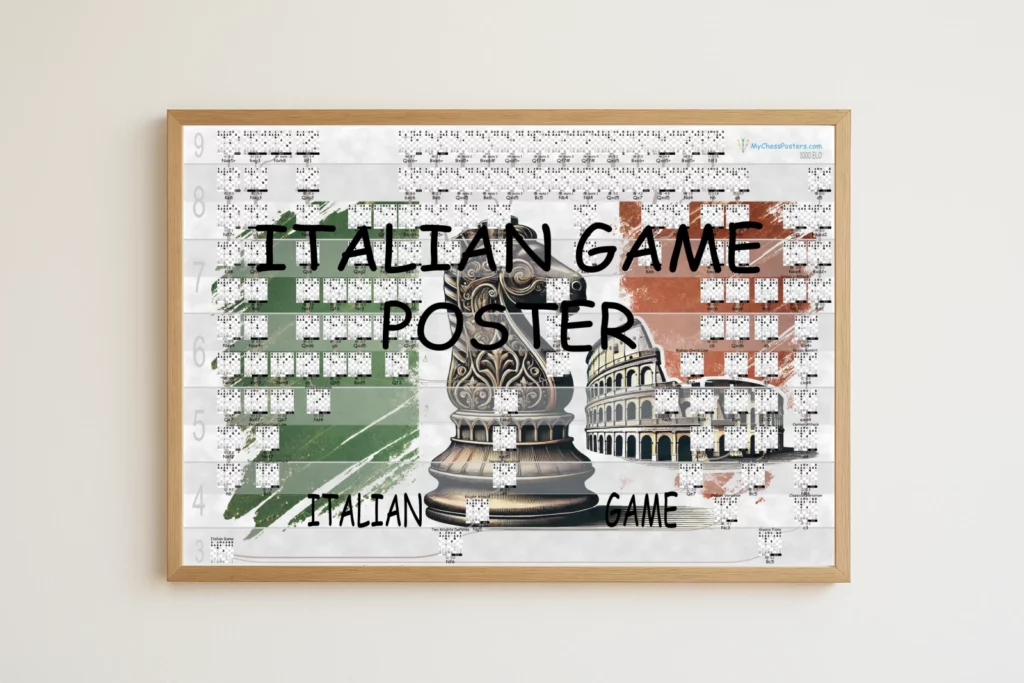
Research in chess education consistently shows that visual pattern recognition develops faster than notation memorization. Strong players don’t calculate 1.e4 e5 2.Nf3 during games; they recognize the position instantly. Building this recognition through diagrams accelerates the process.
Practical Application: using an Italian Game chess opening diagram in your preparation
How should you actually use Italian Game diagrams in your chess improvement? Start by identifying your current ELO range and focusing on variations that perform best at your level. The data table above shows 3…Bc5 4.c3 dominates at 1000 ELO, so players in that range should prioritize learning this tactical line.
Next, study the critical positions as diagrams rather than move sequences. When you recognize the 7.Bd2 position from the Giuoco Piano, you’ll automatically know the strategic themes: White wants to maintain the center, Black needs to challenge it. This positional understanding guides your moves even in unfamiliar situations.
Finally, review your own games by comparing them to standard diagrams. Where did you deviate from the main lines? What happened afterward? This active comparison builds pattern recognition faster than passive study.
For players serious about mastering the Italian Game visually, our data-driven Italian Game poster displays every major variation with win rates from thousand Lichess games, organized as a visual decision tree. It’s designed specifically for the visual learner who wants to see the opening rather than read about it.
Conclusion
The Italian Game chess opening diagram approach transforms how you learn this classical opening. Instead of drowning in notation, you see the opening as a connected structure where each branch leads logically to the next. Three key insights emerge from our visual analysis.
First, the Italian Game splits cleanly into the strategic Giuoco Piano and the tactical Two Knights Defense, each requiring different skills. Second, win rates vary dramatically by ELO level, with aggressive lines like 4.Ng5 performing best at lower ratings. Third, visual pattern recognition beats notation memorization for practical game improvement.
Understanding which lines actually win games at YOUR level is the key to climbing from 1000 to 1400 to 1800 ELO. Our Italian Game Chess Poster visualizes every critical variation with real win rates from thousand Lichess games, ELO-specific statistics, and Stockfish evaluations in a clear decision tree format. See exactly which moves dominate at your level and stop guessing which variation to play.
What’s your experience with the Italian Game? Do you prefer the strategic Giuoco Piano or the tactical Two Knights? Share your favorite line in the comments below.
Frequently Asked Questions
Q1: What is the Italian Game opening in chess?
A: The Italian Game is a chess opening that begins with the moves 1.e4 e5 2.Nf3 Nc6 3.Bc4. White develops the bishop to attack Black’s f7 pawn, the weakest square in Black’s position. This classical opening dates back to the 16th century and remains popular at all levels because it leads to clear strategic and tactical themes that are easy to understand visually through board diagrams.
Q2: How do I read an Italian Game chess diagram?
A: Italian Game diagrams show the board position after specific moves, with pieces displayed on their squares. Decision tree diagrams add arrows showing possible moves and branches, always including win rate percentages. Look for White pieces at the bottom, Black at top. Focus on piece placement, pawn structure, and tactical threats like the bishop aiming at f7.
Q3: What is the best move for White in the Italian Game?
A: After 3.Bc4, White’s best practical move depends on Black’s response and your ELO level. Against 3…Bc5, playing 4.c3 prepares d4 for a strong center. Against 3…Nf6, the aggressive 4.Ng5 scores 59% at 1000 ELO. Data from thousand Lichess games shows aggressive lines outperform passive alternatives at club level, though the advantage narrows at higher ratings.
Q4: What is the difference between Italian Game and Giuoco Piano?
A: The Italian Game is the broader opening family starting with 3.Bc4. The Giuoco Piano is a specific variation within the Italian Game that occurs after 3…Bc5 (meaning “Quiet Game” in Italian). So every Giuoco Piano is an Italian Game, but not every Italian Game is a Giuoco Piano. The Two Knights Defense (3…Nf6) is another major Italian Game branch.
Q5: Why are visual diagrams better for learning chess openings?
A: Visual diagrams activate pattern recognition, which chess masters use during games. Memorizing notation like “1.e4 e5 2.Nf3” requires mental translation, while diagrams show positions directly. Research shows visual learners retain opening knowledge longer and apply it faster under time pressure. Decision tree diagrams also reveal how variations connect, building deeper understanding.
Q6: What is the Fried Liver Attack in the Italian Game?
A: The Fried Liver Attack occurs in the Two Knights Defense after 3…Nf6 4.Ng5 d5 5.exd5 Nxd5 6.Nxf7, sacrificing the knight to expose Black’s king. It’s extremely dangerous for unprepared opponents and scores over 60% at lower ELO levels. Visual diagrams of this line show why the attack works and how Black can avoid it with 5…Na5 instead.
Q7: How many variations does the Italian Game have?
A: The Italian Game contains dozens of named variations, but three main branches cover 90% of practical games. The Giuoco Piano (3…Bc5) leads to strategic play, the Two Knights Defense (3…Nf6) creates tactical complications, and various sidelines exist but score poorly for Black. A comprehensive Italian Game diagram or poster typically displays 15-25 key variations organized by branching structure.
Finally, a visual guide to the Italian Game – much easier to follow than just reading move lists. I found a similar breakdown of strategic thinking applied to a different game on, which helped me understand the concept better.