
Every beginner faces the same dilemma after 1.e4: should you play 1…e5 like everyone recommends, or try something different? The sicilian defense vs italian game for beginners debate has raged for decades—but now we have data to settle it.
After analyzing 1,032,854 Lichess games at 0-800 ELO, one fact stands out: the Sicilian Defense (1…c5) gives Black a 48% win rate, while 1…e5 (leading to the Italian Game) drops to 44%. That 4-point difference might seem small, but it’s the gap between a winning record and a losing one. More importantly, the Sicilian is the only response to 1.e4 where Black wins more than White.


This article breaks down exactly why this difference exists, which opening suits your style, and how to make smarter choices from move one.
Sicilian Defense vs Italian Game for Beginners: Why Your First Move Matters
Most beginners treat Black’s first move as automatic. White plays e4, you play e5, done. But this casual approach ignores a critical reality: your first move shapes the entire game.
The sicilian defense vs italian game for beginners question isn’t just theoretical—it has real consequences. Choosing 1…c5 creates asymmetrical, fighting positions. Choosing 1…e5 leads to classical structures where White has clear plans.
At 0-800 ELO, these structural differences translate directly into results. Over 100 games, that 4-point edge means 4 extra wins simply from your opening choice. Not from studying tactics harder. Not from calculating deeper. Just from picking the right first move.

The Main Chess Openings Poster (0-800 ELO) displays this exact decision point with color-coded statistics, making the comparison instantly clear.

Complete Win Rate Comparison: Every Response to 1.e4
Let’s examine all major options for Black. The data comes from over one million games at beginner level:
| Black’s Response | Games | White Wins | Black Wins | Draws |
|---|---|---|---|---|
| 1…e5 (→ Italian) | 647,508 | 50% | 44% | 6% |
| 1…d5 (Scandinavian) | 89,649 | 49% | 45% | 6% |
| 1…c6 (French) | 62,158 | 48% | 46% | 6% |
| 1…Nf6 (Alekhine) | 54,018 | 50% | 44% | 6% |
| 1…c5 (Sicilian) | 47,189 | 47% | 48% | 5% |
| 1…d6 (Pirc) | 31,285 | 55% | 39% | 6% |
The pattern is striking. Every response except the Sicilian gives White more wins than Black. The Sicilian flips this dynamic—Black actually wins more often (48% black vs 47% white).
Notice that 1…e5 is played in 62.71% of games at this level. Meanwhile, the statistically superior Sicilian appears in only 4.57%. Most beginners follow conventional wisdom without questioning whether it actually works.
Why the Sicilian Defense Beats Italian Game Lines for Beginners
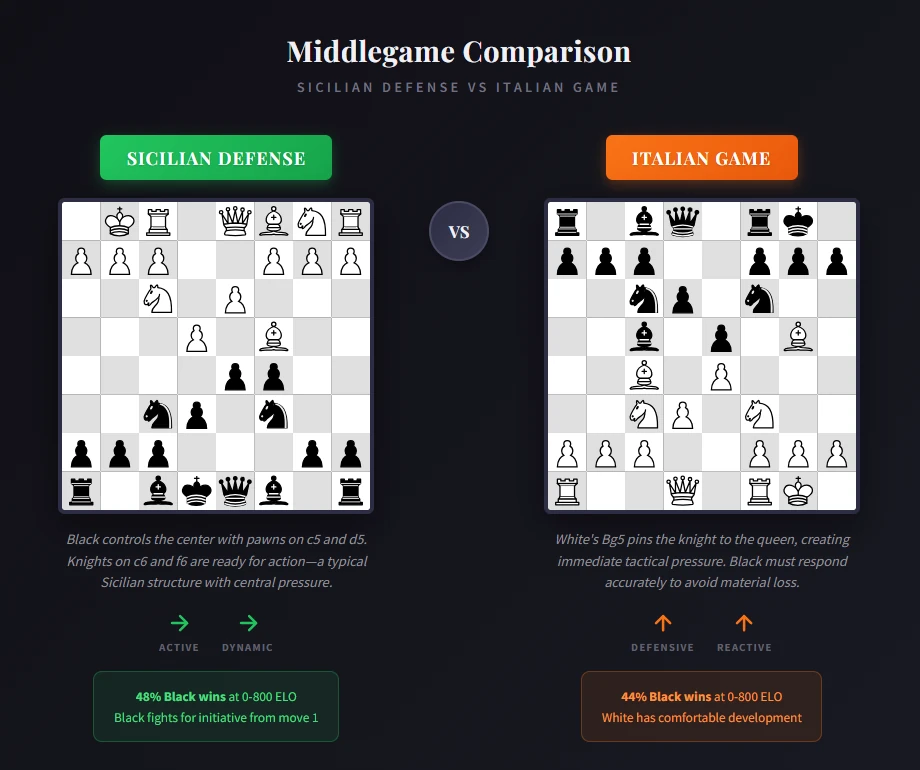
The 4-point advantage isn’t random. Three factors explain why the sicilian defense vs italian game for beginners comparison favors c5:
Factor 1: Asymmetry Creates Mutual Confusion
After 1…e5, White has familiar attacking patterns—develop pieces, castle, target the king. These plans are intuitive and easy to execute. After 1…c5, both players face unusual pawn structures. Your opponent’s prepared ideas become useless.
At 0-800 ELO, confusion affects both sides equally. But in asymmetrical Sicilian positions, there’s more room for creative play. In symmetrical Italian positions, the player with better technique usually wins—and that’s typically White with the first-move advantage.
Factor 2: Active Counterplay vs Passive Defense
The Italian Game often requires Black to defend accurately for many moves before counterattacking. One slip and White’s initiative grows dangerous. The Sicilian gives Black immediate counterplay on the queenside, creating threats rather than just responding to them.
Factor 3: The Preparation Gap
Your opponents prepare for 1…e5. They’ve watched videos on the Italian Game, studied the Fried Liver Attack, practiced their favorite lines. They haven’t prepared for the Sicilian because so few beginners play it. You gain a practical edge before the middlegame begins.
The Pirc Defense Trap: Avoid 1…d6
If the Sicilian is underplayed, the Pirc Defense (1…d6) is the opposite problem—played too often despite terrible results.
The numbers are harsh: 55% White wins, only 39% Black wins. That’s a 9-point disadvantage compared to the Sicilian. Playing 1…d6 at beginner level is essentially giving your opponent a head start.
Why does it fail? The Pirc requires understanding hypermodern concepts—letting White build a big center, then attacking it later. Beginners lack the positional understanding to execute this strategy. Instead, they watch White’s pawns roll forward while their counterattack never materializes.
If you’ve been playing the Pirc, switch immediately. The Sicilian offers similar fighting spirit with drastically better results.
Is the Sicilian “Too Hard” for Beginners? The Myth Debunked
The most common objection: “The Sicilian is too complicated for beginners.” Let’s examine this claim against the evidence.
The sicilian defense vs italian game for beginners debate often assumes that “simple” equals “better.” But simplicity in the Italian Game means clear plans for White. Simplicity in the Sicilian means clear plans for both sides.
Consider what “complicated” actually means at 0-800 ELO:
- Neither player knows deep theory
- Both players make tactical mistakes
- Games are decided by practical factors, not preparation
In this context, the Sicilian’s complexity is neutral at worst, advantageous at best. Your opponent doesn’t know the “correct” anti-Sicilian systems. You don’t need to know 20 moves of theory—just understand basic ideas like queenside expansion and piece activity.
The best chess openings for beginners guide explores how practical results should guide opening choices, not theoretical reputation.
Italian Game for Beginners: When 1…e5 Makes Sense
Despite the statistics, the Italian Game (via 1…e5) isn’t wrong for everyone. Understanding both sides of the sicilian defense vs italian game for beginners question helps you make an informed choice.
Choose 1…e5 and the Italian Game if:
- You prefer classical, structured positions
- You want extensive learning resources (books, videos, courses)
- You plan to invest heavily in opening study
- You enjoy defensive challenges
The Italian Game has centuries of theory. Finding study material is easy. If you’re the type who enjoys memorizing variations and understanding deep positional ideas, this path offers rich learning opportunities.
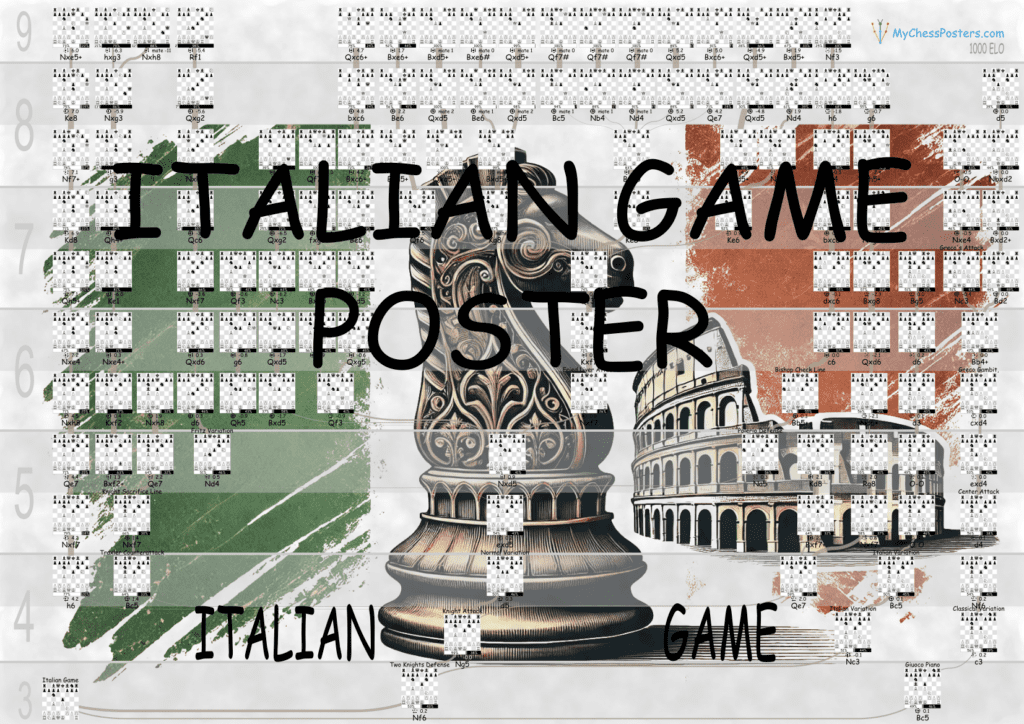
The Italian Game Chess Poster visualizes all major variations with win rates, helping you understand which lines score best at 1000 ELO.
Choose the Sicilian Defense if:
- You prefer active, fighting chess
- You want to surprise opponents
- You value practical results over theoretical correctness
- You dislike passive defense
The Sicilian rewards aggression and creativity. You’ll face fewer opponents who know the theory, giving you practical edges that compound over many games.
Sicilian Defense vs Italian Game for Beginners: How to Choose Based on Your Style
The sicilian defense vs italian game for beginners choice ultimately depends on what you value.
If you optimize for winning: The Sicilian’s 48% win rate beats 1…e5’s 44%. Over time, this edge accumulates into rating points.
If you optimize for learning: Both openings teach valuable skills. The Italian teaches classical principles; the Sicilian teaches dynamic play. Neither is wrong for development.
If you optimize for enjoyment: Play whatever makes chess fun. A 4-point statistical edge means nothing if you hate your positions.
Many strong players learn both eventually. Starting with the Sicilian gives you immediate practical benefits while you develop broader chess understanding.
Visualize Your Openings for Faster Learning
Understanding statistics is the first step. Remembering the right moves during games is the harder challenge.
Visual learning accelerates this process. When you see opening variations as branching decision trees with win rates displayed, patterns stick faster than abstract notation. Your brain processes visual information more efficiently than text.
Our data-driven posters apply this principle to chess openings. Each variation shows its practical performance at your specific ELO level—not grandmaster statistics that don’t apply to your games.
Conclusion Sicilian Defense vs Italian Game for Beginners
The sicilian defense vs italian game for beginners question has a clear statistical answer: the Sicilian’s 48% Black win rate beats the Italian path’s 44%. Across over one million games, 1…c5 is the only response to 1.e4 where Black wins more than White.
Key takeaways from the data:
- Sicilian Defense: 48% Black wins, 47% White wins—unique advantage for Black
- Italian Game (via 1…e5): 44% Black wins, 50% White wins—standard but disadvantaged
- Pirc Defense (1…d6): 39% Black wins—avoid completely at beginner level
- Underutilized opportunity: Only 4.57% of beginners play the Sicilian despite best results
The Main Chess Openings Poster visualizes all responses to 1.e4 with real Lichess statistics. See instantly why c5 outperforms e5 and make data-driven opening choices.
For players ready to master Sicilian variations at higher levels, the Sicilian Defense Chess Poster covers advanced lines with the same statistical approach.
Your turn: Have you tried the Sicilian as Black? Did your results improve? Share your experience in the comments.
Frequently Asked Questions
Q1: Sicilian Defense vs Italian Game for Beginners: Is the Sicilian Defense good for beginners?
A: Yes. At 0-800 ELO, the Sicilian achieves 48% wins for Black versus 47% for White—the only response to 1.e4 where Black has a statistical edge. The “too complicated” reputation ignores that your opponents are equally unfamiliar with these positions at beginner level.
Q2: What is the win rate difference between Sicilian and Italian Game for Black?
A: Black wins 48% with the Sicilian Defense versus 44% after 1…e5 (Italian Game path). This 4-point difference translates to approximately 4 extra wins per 100 games—enough to impact your rating over time.
Q3: Sicilian Defense vs Italian Game for Beginners: Is the Italian Game or Sicilian better for Black?
A: Statistically, the Sicilian is better for Black at beginner level (48% vs 44% win rate). However, the Italian Game offers more structured learning resources. Choose based on whether you prioritize results or traditional instruction.
Q4: What is the best response to 1.e4 for beginners?
A: Based on 1,032,854 Lichess games at 0-800 ELO, the Sicilian Defense (1…c5) produces the best results for Black. It’s the only response where Black’s win percentage exceeds White’s, yet only 4.57% of beginners play it.
Q5: Why do most beginners play 1…e5 instead of the Sicilian?
A: Tradition and teaching materials. Most beginner courses start with 1…e5 because it leads to “classical” positions. However, 62.71% of beginners following this advice face worse statistical outcomes than the 4.57% who play the Sicilian.
Q6: What is the worst response to 1.e4 at beginner level?
A: The Pirc Defense (1…d6) with only 39% Black wins versus 55% White wins. It requires hypermodern understanding that beginners lack. Avoid it until you reach intermediate level.
Q7: Should I learn both the Sicilian and Italian Game?
A: Eventually, yes. Understanding both helps you play either side effectively. Starting with the Sicilian gives immediate practical benefits, while learning the Italian later adds positional understanding to your repertoire.
Q8: How do visual posters help with opening memorization?
A: Visual decision trees engage spatial memory, making variations easier to recall than abstract notation. Color-coded win rates show which lines work at your specific ELO, eliminating guesswork and accelerating learning through passive exposure.